Why Is My AC Not Cooling in Jacksonville Summer?
Jacksonville's 95°F summers and 80% humidity overwhelm weak AC systems. Here are the real reasons your AC blows warm air and what it costs to fix in 2026.
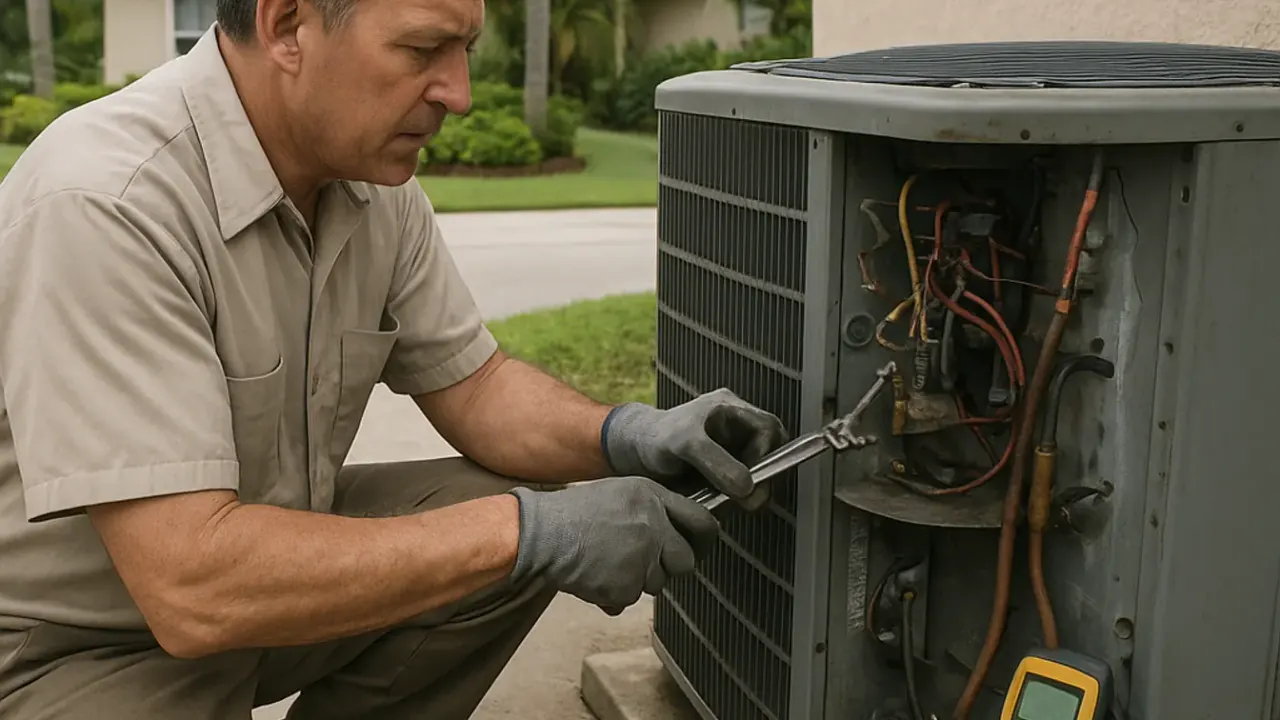
Your AC is not cooling in Jacksonville summer because one of seven things has failed: a clogged air filter, a frozen evaporator coil, low refrigerant from a leak, a dead capacitor or compressor, a thermostat fault, dirty condenser coils, or duct leaks pulling 90°F attic air into your rooms. In Jacksonville's July and August heat - 95°F with 80% humidity - a system that is only 10% undercharged can lose 20°F of cooling capacity, so even a small fault feels like total failure. Below we walk through each cause, what you can safely check yourself, what 2026 repair costs look like here, and when to stop guessing and call us.
The Short Answer: Why Jacksonville AC Units Stop Cooling
Why is my AC not cooling in Jacksonville summer is a question our technicians hear 40 times a day from June through September, and the answer is almost never "your AC is old." It is almost always airflow, refrigerant, or electrical. Those three categories cover roughly 90% of the no-cool calls we run in Duval and St. Johns County.
Here is the definitional version: AC not cooling in Jacksonville summer is a performance failure that happens when your system cannot move enough heat out of your home fast enough to beat the outdoor load. Your AC does not make cold air - it removes heat. When the outdoor temperature hits 95°F and your attic is 140°F, the system has to work three times harder than it does in April. Any weak link in that chain shows up as warm air at the vents.
For a full-service team that handles everything from a $180 capacitor swap to a full system replacement, our hvac jacksonville FL page covers what we do across the metro. But before you call anyone, read the next section - you may be able to fix this in ten minutes.
Jacksonville Humidity Is Half the Problem
Jacksonville humidity is the single biggest difference between an AC problem here and the same problem in Phoenix or Denver. Our average July dew point sits near 75°F. That means your system spends half its runtime just pulling water out of the air, not lowering the temperature.
A properly sized 3-ton unit in Jacksonville removes about 3 gallons of condensate per hour on a 95°F day. If your drain line is partially clogged - which happens constantly here because of pollen, algae, and the fine grit that blows off the St. Johns River - the coil sits in its own water, freezes, and stops cooling entirely. That is the number one cause of "AC blowing warm air Jacksonville FL" calls we get in July.
You can check this yourself. Find the PVC condensate drain near your indoor air handler, usually in the garage, attic, or a closet. If it is wet, slimy, or you see standing water in the pan, that is your problem. Clear it with a shop vac on the outdoor end, then pour a cup of white vinegar down the tee to slow the algae regrowth.
Humidity also explains why your house feels clammy even when the thermostat reads 74°F. If the system is short-cycling - turning on and off every 5 to 7 minutes - it never runs long enough to dehumidify. That points to an oversized unit, a bad thermostat, or a refrigerant charge issue, and it needs a technician.
7 Common AC Problems Jacksonville Homeowners Face in Summer
Common AC problems Jacksonville summer throws at us fall into seven buckets. We rank them here by how often we actually see them on service calls, not by how scary they sound.
- Clogged air filter. A 1-inch filter in a Jacksonville home with pets or a nearby construction site clogs in 30 days, not 90. A dirty filter cuts airflow by 30-50% and freezes the coil within hours.
- Frozen evaporator coil. Ice on the indoor coil blocks all airflow. You will see frost on the copper lines or water pooling under the air handler. Turn the system off, run the fan only for 2-3 hours, and check the filter and drain before restarting.
- Low refrigerant from a leak. A system that is 10% low on R-410A loses roughly 20% of its capacity. If you had to add refrigerant last summer and need it again, you have a leak - topping it off is a temporary band-aid, not a repair.
- Failed run capacitor. This $30 part starts the compressor and condenser fan. When it bulges or fails, the outdoor unit hums but the fan does not spin. This is a $180-$320 repair in 2026 and one of the most common calls we run.
- Bad compressor. If the compressor is dead, the outdoor unit runs but pushes no heat. Compressor replacement runs $1,400-$2,200 installed; on a system over 12 years old, replacement usually makes more financial sense.
- Thermostat or control board fault. A thermostat stuck in "fan only" or a failed control board tells the system to run without cooling. Check that your thermostat is set to COOL, not AUTO or FAN, and that the batteries are fresh.
- Duct leaks and attic heat gain. Jacksonville attics hit 140°F in August. A 20% duct leak in that environment dumps 130°F air into your supply trunks. We find measurable duct leakage in roughly 6 out of 10 homes built before 2005.
If you are dealing with a system that is 15 years old and has needed three repairs in two summers, the math usually points toward replacement rather than another patch. Our air conditioning installation jacksonville FL team walks you through sizing, SEER2 ratings, and what a right-sized unit looks like for a 1,800-square-foot Mandarin or Riverside home.
How to Fix AC Not Cooling in Jacksonville: What You Can Check First
How to fix AC not cooling Jacksonville is mostly a process of elimination, and you can safely rule out four things before you pick up the phone. Do these in order - each takes under five minutes.
1. Check the filter and the return grille
Pull the filter and hold it up to a light. If you cannot see through it, replace it. While you are there, make sure no furniture, rugs, or boxes are blocking the return grille. We see this constantly in condos near the Beaches where a couch gets pushed against the return.
2. Check the outdoor unit
Go outside and look at the condenser. Is the fan spinning? Is there frost on the copper lines? Is the unit buried in weeds, palm fronds, or dryer lint? Clear 24 inches of space around it and hose off the fins from the inside out. A dirty condenser coil alone can cut efficiency by 25%.
3. Check the breaker and the float switch
Look at your electrical panel. If the AC breaker is tripped, reset it once. If it trips again immediately, stop - you have a short or a failing compressor, and resetting it repeatedly will burn out the unit. Also check the condensate float switch; many Jacksonville installs have a safety switch that shuts the system off when the drain pan fills.
4. Check the thermostat
Set it to COOL at 72°F and listen. If you hear the indoor blower but the outdoor unit never kicks on, you have a low-voltage, capacitor, or compressor issue. If nothing happens at all, it is likely the thermostat or the control board.
If you have done all four and the air is still warm, the problem is refrigerant, electrical, or ductwork - three things that need gauges, a multimeter, and a duct blaster. That is when a pro saves you money instead of costing you money.
What to Watch Out For: Mistakes That Make It Worse
The biggest mistake Jacksonville homeowners make when the AC stops cooling is running the system anyway. If the coil is frozen or the compressor is short-cycling, every hour you run it pushes the repair bill higher. A $180 capacitor becomes a $2,000 compressor replacement fast.
Second mistake: adding refrigerant from a DIY can. Those cans sold at big-box stores often contain sealants that gum up the metering device and the compressor. We have seen a $12 can turn into a $3,400 system replacement more than once.
Third mistake: ignoring the drain. In Jacksonville, a clogged condensate line does not just stop cooling - it overflows into your ceiling, your drywall, and sometimes your electrical panel. A $150 drain clearing is a lot cheaper than a $4,000 water damage repair.
Fourth mistake: replacing the whole system when the problem is ductwork. If your ducts are leaking 20-30% of your cooled air into the attic, a new $8,000 AC will underperform the old one. We test static pressure and duct leakage before we ever quote a replacement. If your ducts are the real problem, our hvac duct sealing jacksonville FL service typically runs $600-$1,800 and often fixes the cooling complaint without touching the equipment.
When to Call a Professional
Call a professional when the outdoor unit will not start, when you see ice on the coil or lines, when the breaker trips more than once, or when you have added refrigerant in the last 12 months. Those four situations are beyond what a homeowner can safely diagnose, and two of them can damage the system further if you keep running it.
Our team at AirCrest Jacksonville HVAC handles same-day AC diagnostics across Duval, Clay, and St. Johns County. We show up with gauges, a leak detector, and a duct blaster, and we tell you the actual cause before we quote a repair. If you are in one of the older neighborhoods - Avondale, San Marco, Springfield - where 1950s ductwork and modern high-efficiency equipment often fight each other, we see this pattern weekly. Homeowners searching for ac repair jacksonville FL usually find us because a neighbor sent them.
If your system is under 10 years old and the repair is under $700, fix it. If it is over 12 years old, uses R-22 refrigerant, or has needed three repairs in two summers, replacement is usually the smarter money. We will give you both numbers and let you decide.
Frequently Asked Questions
Why is my AC not cooling in Jacksonville summer?
The most common cause is a frozen evaporator coil from restricted airflow - usually a clogged filter or a blocked condensate drain. Jacksonville's 80% humidity makes drain clogs far more frequent here than in drier climates. Low refrigerant, a failed capacitor, and duct leaks round out the top four.
What causes AC to stop cooling in Jacksonville?
Jacksonville-specific causes are humidity-driven drain clogs, pollen-heavy condenser coils, and attic duct leaks that pull 130°F air into the supply. Add the standard failures - capacitor, compressor, refrigerant leak - and you have 95% of the calls we run between May and September.
How do I fix my AC not cooling in Jacksonville?
Start with the filter, then the outdoor unit, then the breaker, then the thermostat. If all four check out and the air is still warm, stop. Refrigerant and electrical work require a licensed technician and a set of gauges. Running a frozen or short-cycling system for a day can double the repair cost.
Should I call HVAC if my AC is not cooling in Jacksonville?
Yes - call the same day if the outdoor unit will not start, if you see ice on the copper lines, if the breaker trips twice, or if you added refrigerant last summer. Those four symptoms point to problems that get worse the longer the system runs. A diagnostic visit in 2026 runs $89-$150 in Jacksonville.
How much does AC repair cost in Jacksonville in 2026?
Typical 2026 pricing here: capacitor replacement $180-$320, condensate drain clearing $150-$250, refrigerant leak repair $400-$900 plus refrigerant, blower motor $450-$800, and compressor replacement $1,400-$2,200. Full system replacement runs $6,500-$11,000 depending on tonnage and SEER2 rating.
Get Help With HVAC in Jacksonville
Warm air in July is not something you should have to live with, and it is rarely as expensive to fix as homeowners fear. We diagnose the actual cause, show you the part, and give you a flat price before we start.
Call AirCrest Jacksonville HVAC at (312) 638-0812 for same-day AC repair across Jacksonville and the surrounding counties.